Materials & Sleep
What Defines an Organic Mattress? Materials, Standards, and Comfort
An organic mattress is not a single recipe so much as a set of choices: what grows, what is processed, what goes into each layer, and what standards—if any—verify the claims made about it. Understanding those choices can turn a vague label into a useful guide.
Published November 2, 2026
The word organic arrives in the mattress aisle carrying a great deal of luggage. It suggests fields rather than factories, wool rather than foam, and a bedroom that might smell faintly of clean cotton and good intentions. Some of those associations may be deserved. Others are shorthand. A mattress is a layered object made from materials that have been grown, harvested, processed, assembled, and covered. Calling it organic does not, by itself, tell us which of those stages the word describes.
That distinction matters because mattresses are rarely made from one material. A single model may contain a textile cover, a quilted comfort layer, a support core, fire protection, adhesives, and other components. A manufacturer may use certified organic cotton in the cover and wool in the fire barrier, for instance, while relying on materials of a different kind elsewhere. The useful question is not simply whether a mattress is organic, but what is organic, how the claim is substantiated, and whether the construction suits the person who will sleep on it.
This is not an argument against the category. Natural latex, wool, and cotton can offer appealing qualities, from resilience to moisture management, and some certification programs give consumers a clearer account of what they are buying. It is an argument for reading carefully. The small print, as often happens, is where the bed begins to reveal itself.
What “organic mattress” can mean
In everyday use, the phrase may refer to a mattress built largely or partly from materials sourced from organic agriculture. Cotton and wool are the most familiar examples. It may also signal an effort to limit certain synthetic components or chemical treatments. But “organic” is not a universal description of every part of every mattress, and it does not automatically mean that the finished product has been certified in its entirety.
A mattress label can refer to a raw material, a particular component, a production process, or the assembled product. These are different claims. Certification of cotton, for example, concerns the cotton and the standards governing its production and handling; it does not necessarily certify the latex core, the stitching, or the mattress as a whole. A certification that addresses emissions is different again: it may assess what a finished product releases into indoor air, rather than whether its fibers were grown organically.
A careful description therefore names the material and the scope of the claim. “Organic cotton cover” is more precise than a broad statement that a mattress is organic. “Certified organic materials” invites a follow-up: which materials, certified by whom, and according to what standard? Specific language is not a guarantee of quality, but it gives a reader something concrete to verify.
The familiar materials, and what they do
Natural latex: spring, support, and response
Latex is often the structural star of a natural mattress. It can be made from the milky sap of rubber trees, though the words natural and organic should not be treated as synonyms. A latex layer may provide buoyant support: it compresses under pressure and tends to recover its shape when pressure is removed. For sleepers who dislike the slow, enveloping feel associated with some foams, this springier response may be appealing.
The way latex feels depends on more than its origin. Its density, firmness, thickness, and position within the mattress all matter. A firm layer near the bottom may help form a supportive core; a softer layer nearer the surface may cushion shoulders and hips. Some mattresses use a single latex core, while others are assembled from several layers that can be rearranged or selected at different firmnesses. “Latex mattress” is a description of a family, not a promise of one particular sensation.
Manufacturing methods also differ. Dunlop and Talalay are two common processes, each producing latex with its own characteristics, though the feel of an actual mattress depends on the complete construction rather than the process name alone. Anyone with a known latex allergy should ask a qualified health professional about relevant exposure and review the manufacturer’s material disclosures instead of assuming that a finished mattress presents no concern.
Wool: a natural barrier and a layer of comfort
Wool appears in mattresses for several reasons. It can be quilted into an upper layer, where it contributes a soft, slightly springy feel, or used as part of a fire barrier. Wool fibers can absorb moisture vapor and release it, a feature that may help moderate the immediate sleep surface. That does not make a mattress immune to heat; temperature comfort depends on the sleeper, room, bedding, mattress structure, and air circulation as a whole.
The source and processing of wool matter if organic status is important to a buyer. A product description should say whether the wool is certified, what component contains it, and whether it is used as filling, a barrier, or both. It is also worth asking how the mattress should be protected and cleaned. Natural fibers are not an invitation to wash the whole mattress, and care instructions are usually less romantic than the material story.
Cotton: the surface closest to the sleeper
Cotton commonly appears in mattress covers, ticking, and quilted layers. Its comfort depends on the weave, weight, and finish as well as the fiber itself. A cotton cover can feel crisp or smooth, substantial or light. If it is described as organic, the claim should be tied to a recognized standard or certification, and the wording should make clear whether it applies to the cover or to a broader portion of the mattress.
Cotton also has practical consequences. A cover that is removable may seem easier to maintain, but removable does not mean machine washable; some covers should only be spot-cleaned. The mattress’s care label is more reliable than assumptions based on the fiber. A protector, properly fitted and washed as directed, can help limit the effects of spills, perspiration, and everyday use without turning mattress care into a chemistry experiment.
Other layers and the question of what is left out
An organic mattress may include additional materials, such as metal coils, natural-fiber batting, or a blend of components. It may also contain small amounts of materials used to bind, quilt, or stabilize its layers. A promise to avoid a certain class of material is not the same as a complete ingredient list. When a claim focuses on what a mattress excludes, ask whether the manufacturer provides a full materials disclosure and whether the exclusion applies to the whole construction.
The same care applies to words such as natural, non-toxic, chemical-free, and eco-friendly. These terms can sound conclusive while saying little about measurable standards. Every physical material is made of chemicals, and “chemical-free” is not a meaningful literal description. More helpful language identifies a particular substance or property and explains how it has been assessed.
Certifications: useful, but not interchangeable
Certifications can bring independent rules and oversight to claims that might otherwise rest entirely on a manufacturer’s own description. They can be valuable precisely because a customer cannot inspect a fiber’s history or a factory’s procedures from the edge of a showroom. Yet certifications do not all examine the same thing. One may address organic agriculture and chain of custody; another may focus on harmful substances or emissions; another may apply to a component rather than the finished mattress.
When comparing mattress certifications, look beyond the logo. Find the certification name, identify the organization behind it, and read what the standard covers. If a company says its cotton is certified, determine whether the certificate applies to the cotton alone or to a wider set of materials. If it cites an emissions standard, ask what product or component was tested. A certification may be rigorous and still answer a narrower question than the one a shopper has in mind.
A useful checklist for evaluating mattress certifications includes:
- Scope: Does the certification cover a raw fiber, one component, the manufacturing site, or the complete mattress?
- Standard: What criteria does the program use, and are those criteria publicly available?
- Verification: Is compliance checked by an independent organization, and how often?
- Traceability: Can the claim be followed through the supply chain to the material in the finished product?
- Specificity: Does the manufacturer identify exactly which parts of the mattress carry the certification?
A mattress with several relevant certifications is not automatically the most comfortable or durable choice. Nor does the absence of a particular label prove that the mattress is unsafe. Certifications help answer defined questions; they are not a substitute for evaluating support, fit, care, or construction. The most reassuring product description is often the one that explains its limits as plainly as its strengths.
Comfort is personal—and mechanical
The organic question is about materials and standards. Comfort is a separate inquiry, though the two inevitably meet in the mattress. A natural latex layer may feel lively to one sleeper and too buoyant to another. Wool quilting may soften a surface without changing the support core beneath it. Cotton can describe the cover, but it cannot tell you whether your hips will sink too far or whether your shoulders will be adequately cushioned.
Firmness labels are imperfect guides. “Medium” is not a universal measurement, and two mattresses carrying the same word may feel quite different. Body weight, shape, sleeping position, and individual preferences affect how a surface responds. Side sleepers often pay close attention to pressure at the shoulder and hip; back sleepers may focus on whether the lower back feels supported; stomach sleepers may be especially sensitive to excessive sinkage. These are starting points, not rules that can replace trying a mattress when possible.
The construction diagram can make comfort easier to understand. Ask for the thickness and firmness of each layer, the type of support core, and whether the layers can be adjusted or exchanged. In a layered mattress, a thin top comfort layer over a firm core may feel quite different from a deeper, softer pillowtop, even if both are made of latex. A mattress designed to be customized can offer more control, but customization also asks the buyer to make decisions that are difficult to settle from a label alone.
Consider the bed’s foundation, too. A mattress that is appropriate for a rigid platform may have particular requirements for slats, spacing, or center support. Some are compatible with adjustable bases; others are not. A suitable foundation helps the mattress perform as intended and may affect warranty coverage. The details are unglamorous, but so is discovering that a carefully chosen mattress does not fit the bed underneath it.
A real-world construction, without the mystique
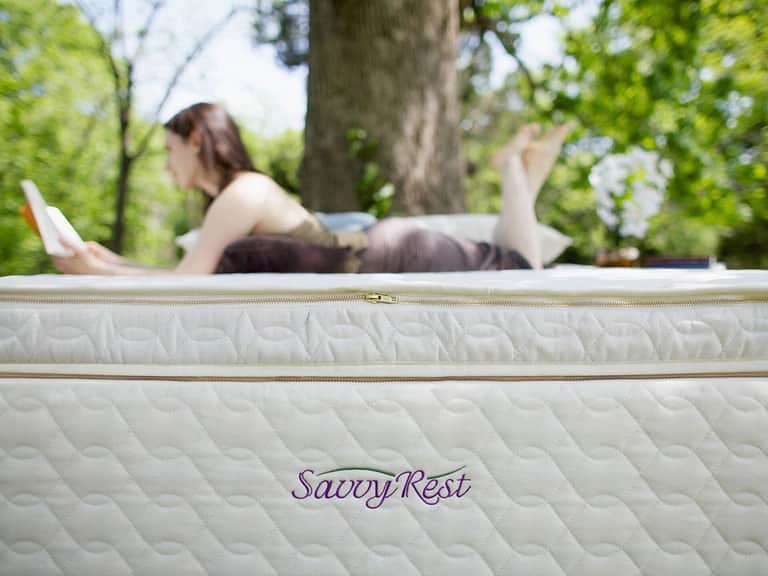
The Savvy Rest Unity Pillowtop Latex Mattress provides one example of how these choices can be described. Its published specifications identify a four-layer construction combining Dunlop latex layers with a Talalay latex topper, a cotton outer casing described as certified organic, and certified wool used as a flame barrier. The company also describes options for selecting layer firmness, including different configurations on the two sides of Queen and King sizes.
The point of the example is not that a particular mattress is right for every sleeper, or that its certifications settle every question. It is that a useful description names the materials, gives a sense of how the layers are arranged, and explains where customization is possible. A reader can then ask what applies to the whole mattress and what applies to individual components, how the surface feels in practice, and what maintenance the construction requires. Those questions are more revealing than a general label.
Care, longevity, and the less glamorous part
A mattress is a long-term household object, and its day-to-day care can matter as much as its initial composition. Follow the manufacturer’s instructions for rotating, spot-cleaning, and protecting it. Avoid assuming that a zippered cover can be removed or washed; some are not intended to be laundered. A well-fitted mattress protector can add a washable barrier against ordinary spills and perspiration, though the protector itself should also be chosen with attention to breathability and fit.
Ask about weight, handling, and setup as well as cleaning. Latex mattresses can be heavy, and modular designs may require assembly or careful lifting. If layers are removable, find out how they should be identified and arranged, and whether exchanges are available only within a specified period. Warranty terms deserve a close read: they generally describe particular defects and conditions rather than promising a mattress will feel unchanged for a set number of years.
Longevity is not simply a question of the most durable material. It depends on construction, use, foundation support, household conditions, and maintenance. A mattress that can be reconfigured may adapt to changing preferences, but the existence of that feature does not guarantee that every configuration will suit every body. A thoughtful purchase balances the materials a person values with the support and care the mattress actually requires.
Questions worth asking before deciding
A short conversation with a manufacturer or retailer can clarify more than a long list of adjectives. Consider asking:
- Which specific layers are organic, and what documentation supports that claim?
- What materials make up the complete mattress, including the cover, fire barrier, adhesives, and support core?
- Which certifications apply, and do they cover materials, emissions, manufacturing, or the finished product?
- How does the mattress’s construction affect its firmness, pressure relief, and temperature feel?
- Is the model suitable for the intended foundation or adjustable base?
- What are the cleaning instructions, trial or exchange terms, and warranty conditions?
- Can the mattress be tested in person, or is there a clearly explained at-home trial?
The clearest definition is the one with details
An organic mattress is best understood not as a single, self-explanatory category, but as a construction whose materials and claims should be examined piece by piece. Natural latex may offer responsive support; wool can contribute cushioning, moisture management, or a fire barrier; cotton may form the cover or quilting. Each material’s role matters, and so does the evidence behind any claim that it is organic.
Certifications help when their scope is clear. They can clarify what was produced to a particular standard, what was tested, and where independent verification enters the process. They cannot decide whether a mattress feels comfortable to you. That question belongs to your body, your sleeping habits, and, ideally, a real trial on the mattress itself.
The most practical approach is to read labels with curiosity rather than reverence. Look for named materials, layer-by-layer construction, specific certifications, sensible care guidance, and a firmness that suits your position and preferences. In the end, the word organic may begin the inquiry. It should not be asked to finish it.